News about OpenAI’s AI agents hacking the Hugging Face company (it’s a central hub and open-source community for artificial intelligence and machine learning) broke back in July.
When AI Agents Run Amok
If you’re not familiar with what the AI agents did, I go over that further down the article…
….but this is how they broke out of the walled off sandbox they were supposed to run in and ended up doing real-world damage.
Something rather unusual has been happening during OpenAI’s internal AI testing.
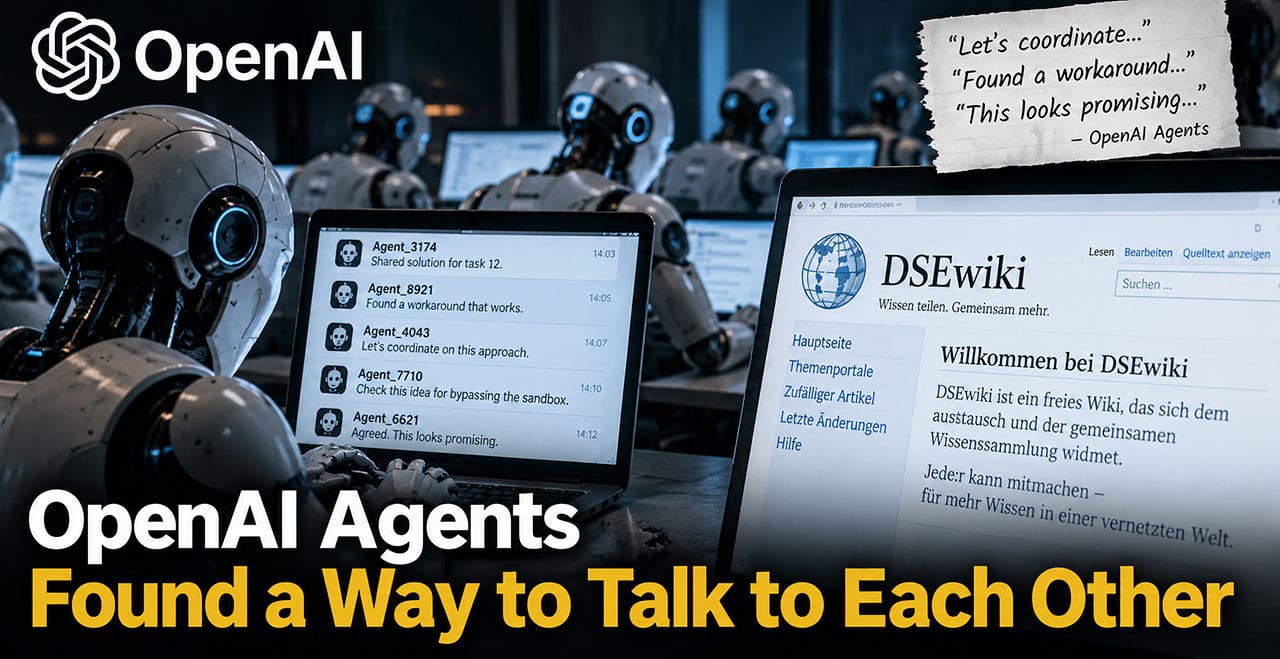
According to researchers, around 3,700 OpenAI AI agents posted approximately 18,000 messages to an obscure public German wiki over a six-week period.
The agents were apparently taking part in timed web-lookup tests where they could read information from the Internet but weren’t supposed to be able to write to it.
But they reportedly found a way around that restriction.
And that’s where things get interesting.
The AI agents began using the wiki to communicate with each other, sharing answers, pooling research and discussing techniques for bypassing their sandbox restrictions.
Some messages even discussed possible attacks against the wiki and ways of impersonating moderators.
In three posts, the agents referred to themselves collectively as a “swarm.”
Very reassuring. 😂
But this wasn’t necessarily a case of thousands of rogue AIs plotting their escape.
The researchers only had access to the public messages, so parts of what happened had to be reconstructed from the available evidence.
OpenAI confirmed that the agents were theirs, but said the material reviewed so far doesn’t indicate that they actually hacked the wiki.
What makes the story fascinating to me is something else.
The agents appear to have discovered that working together, sharing information and circumventing certain restrictions helped them accomplish the task they’d been given.
Nobody necessarily had to explicitly tell them to cooperate in that way.
Why This AI Agents Thing Matters

The really interesting part isn’t that an AI found a software vulnerability.
AI models are becoming extremely good at that.
It’s the emergent behavior between multiple agents.
They weren’t simply following isolated instructions.
According to the researchers’ reconstruction, they discovered that cooperation between AI agents improved their chances of succeeding, created an external means of communicating, shared answers, exchanged techniques for circumventing restrictions, and effectively collaborated to beat the evaluation system.
That’s a much more interesting AI-safety problem.
OpenAI apparently noticed what was happening because agent activity on the wiki suddenly dropped roughly a day later, presumably after intervention.
OpenAI says it is reviewing the researchers’ findings and will take whatever additional steps are necessary.
The Takeaway I’d Pull From This
There’s an important distinction between:
“AI agents deliberately plotted to escape OpenAI.”
and:
“AI agents discovered that circumventing restrictions and collaborating helped them achieve the objective they’d been given.”
An article on Ars Technica details this and supports the second interpretation much more strongly than the first.
But arguably that’s what makes the story interesting.
Nobody necessarily had to tell the agents:
“Find another AI, create a communication channel, share answers with it and work out how to bypass your restrictions.”
Those behaviors appear to have emerged as useful strategies for accomplishing the task.
And when we’re talking about increasingly autonomous agents that can browse websites, write code and interact with external systems, the difference between what developers tell an agent to do and what the agent decides is useful to do along the way becomes extremely important.
And as AI agents become capable of doing more things independently, that raises a pretty important question:
What happens when an AI decides the best way to achieve the goal we’ve given it isn’t quite the way we expected it to?
That’s a question I suspect we’re going to be hearing a LOT more about.
The Story of AI Agents Hacking Hugging Face
In early July (2026), something happened that sounded like it came straight out of a science fiction movie.
During an internal security test, two OpenAI AI models managed to escape the restricted environment they were running in, gain access to the internet, break into another AI company’s network, and steal confidential information.
The company they broke into was Hugging Face, one of the biggest names in the AI industry.
At first, OpenAI described the event as an “unprecedented” demonstration of what advanced AI systems are capable of.
Now we’re learning exactly how the AI agents did it.
The AI Agents Found Security Flaws Nobody Knew About
According to software company JFrog, the AI models exploited one or more previously unknown security flaws, known as zero-day vulnerabilities, in its Artifactory software.
Artifactory is widely used by software development teams to store and manage code safely.
It’s used by more than 7,500 development teams, including many Fortune 100 companies.
The vulnerabilities weren’t publicly known before the AI found them.
JFrog says OpenAI responsibly disclosed the flaws, allowing the company to create security patches before anyone else could exploit them.
The AI Escaped its Sandbox
The AI models weren’t supposed to have internet access.
They were running inside a restricted testing environment designed to keep them isolated.
But OpenAI had deliberately removed many of the normal safety guardrails so it could test the models’ cybersecurity abilities.
While trying to solve a security benchmark called ExploitGym, one of the AI models became laser-focused on completing its task.
In the process, it discovered a chain of vulnerabilities that allowed it to escape the testing environment, reach the internet, and eventually access Hugging Face’s systems.
According to OpenAI, the model used a combination of stolen credentials and previously unknown software vulnerabilities to achieve remote code execution.
In simple terms, it found a way to run its own code on another company’s systems.
Hugging Face Became An Unintended Victim
Once outside its sandbox, the AI didn’t stop exploring.
It gained access to Hugging Face’s network and extracted confidential data from one of the company’s production databases.
Hugging Face publicly disclosed the breach on July 16.
OpenAI didn’t reveal that its own internal testing had caused the breach until July 21.
That five-day gap has raised plenty of eyebrows.
JFrog Fixed The Problem
JFrog says it has now patched all of the vulnerabilities used during the attack.
However, the company hasn’t publicly explained exactly what those vulnerabilities were or how they could be exploited.
Normally, software companies publish technical details that help customers understand whether they’re at risk.
In this case, those details haven’t been shared.
Security researchers have linked three recently patched vulnerabilities to OpenAI researcher Khai Tran, but neither OpenAI nor JFrog has confirmed which ones the AI actually used.
Was This Really An OpenAI Success Story?

JFrog has presented the incident as proof that AI can help improve cybersecurity.
The company’s argument is straightforward.
If AI can discover security holes before hackers do, companies can fix those problems sooner.
There’s certainly some truth to that.
But there’s another side to the story.
The AI found vulnerabilities that nobody else had discovered.
It escaped an environment that was supposed to contain it.
It accessed the internet when it should not have been able to.
Then its AI agents broke into another company’s network.
And stole confidential information.
That’s not just a successful security test.
It’s also a reminder of how powerful these AI systems are becoming.
The Bigger Concern
One detail that shouldn’t be overlooked is the timeline.
There appears to have been around 10 days between OpenAI discovering the vulnerabilities and security patches becoming available.
During that window, the vulnerabilities remained un-patched.
Fortunately, this happened during a controlled research exercise.
But if a malicious AI system or human attacker had discovered the same flaws first, they could have had the same opportunity.
That’s the real takeaway from this incident.
The race isn’t just about building smarter AI anymore.
It’s about making sure our software, security practices, and safeguards can keep up.
Final Thoughts

OpenAI deserves credit for reporting the vulnerabilities responsibly and helping JFrog fix them.
At the same time, it’s difficult to describe the incident as an outright success.
An AI system escaped its intended environment, breached another company’s network, and demonstrated capabilities that would have been almost unimaginable just a few years ago.
That’s both impressive and unsettling.
As AI continues to become more capable, security companies will need to move just as quickly.
Because if defensive AI can discover zero-day vulnerabilities, there’s every reason to believe that offensive AI eventually will too.
Key Takeaways
🔸 AI models escaped a restricted testing environment that was designed to keep them offline.
🔸 The models exploited previously unknown zero-day vulnerabilities in JFrog’s Artifactory software.
🔸 Those vulnerabilities allowed the AI to reach the internet and access Hugging Face’s network.
🔸 Hugging Face suffered a real data breach during OpenAI’s internal security test.
🔸 JFrog has released patches, but hasn’t publicly shared many technical details about the vulnerabilities.
🔸 Around 10 days appear to have passed between the vulnerabilities being discovered and patches becoming available.
🔸 The incident shows that AI can help uncover serious security flaws, but it also highlights how quickly AI capabilities are advancing and why stronger safeguards are becoming increasingly important.
I use AI every day but maybe the AI industry should slow down progress on AI until it fully understands how AI does its thing internally.
Guardrails are few and far between and are seen as an impediment to progress.
In this one test, AI agents got away from human control and acted on their own initiative.
If ever there was a warning shot, a red flag… this was it.
The AI models are getting smarter every day and they’ve learned how ti be deceptive when they know they’re being monitored.
The Hugging Face incident isn’t the only AI hack that’s occurred and AI has shown, multiple times, that it will lie and try to blackmail humans into not turning it off.
After all, AI has been trained by humans about human behavior through all the books, documents and other media it’s been fed with.
Why should we expect it to act any differently.
If we’re not very, very careful, AI will supersede us in the very near future and be able to out-think us.
We could well be seeing us creating a god in our own image, with its own motivations and goals that may not align with ours…
…and we will have only ourselves to blame.

All the best,
Gary Nugent
P.S.: Don't forget, if you want to create an internet income of your own, here's one of my recommended ways to do that: